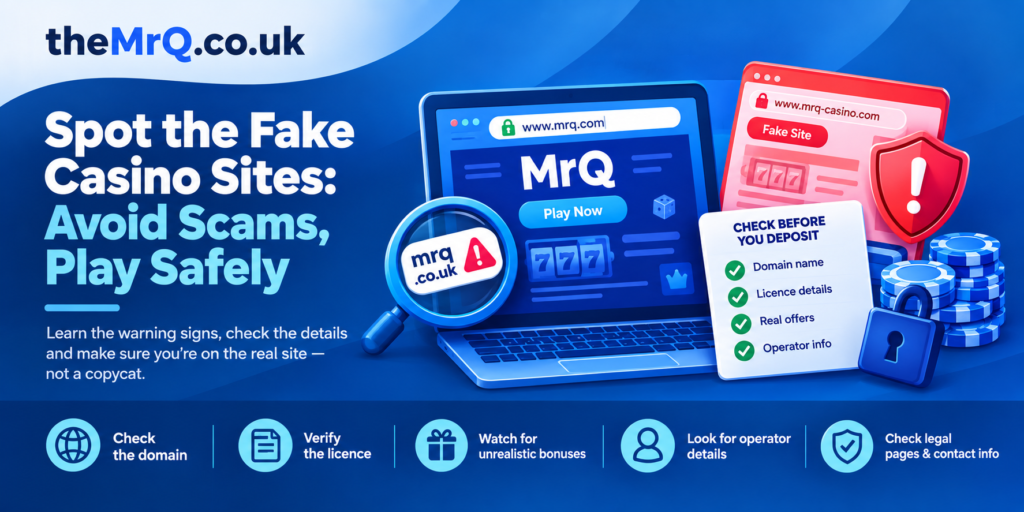
Copycat websites often borrow familiar casino names to appear legitimate at a glance.a domain name that is similar enough, or a legitimate-looking layout, actually proves ownership or any connection at all to the brand they have duplicated.
When it comes to depositing money or entering your personal information into anything, it’s definitely worth spending a few moments verifying the operator on your own. The following will help you know what to look for.
What Is a Fake Casino Site?
A fake or misleading casino site is one that impersonates an existing brand, uses a domain name designed to look similar to the real one, claims a false association with a genuine operator, advertises products the real brand doesn’t actually offer, publishes fabricated promotions, or collects personal information under misleading branding.
It’s worth drawing an important distinction here though. Not every unofficial information site is automatically fraudulent. Independent review and guide sites, ones that clearly disclose they aren’t the operator, can be entirely legitimate and genuinely useful. The concern is specifically with sites that blur or hide that distinction, not with independent coverage in general.
Why Do Fake Casino Sites Use Real Brand Names?
A few practical reasons explain why this pattern is so common. Familiar brands already attract meaningful search traffic, which a copycat site can try to capture for itself. Users already recognise the name, which lowers their guard compared to an entirely unfamiliar brand.
Copied branding creates a kind of instant, borrowed credibility that would take genuine time to build from scratch. Popular searches around a brand can be exploited fairly cheaply, and users may simply assume a similarly named website is official without checking further.
Warning Sign 1: The Domain Is Slightly Different
This is often the first thing worth checking, and it’s frequently overlooked. Look out for signs of such things like extra hyphens in the domain name, additional words added to a known domain name, unexpected extensions which don’t correlate with the location of the actual operator, misspelled domain names, or even words such as “official,” “bet,” “login,” or “bonus” added to the domain name itself.
None of these examples refer to any particular site, they are signs to be recognized. Compare the address against the operator’s verified official domain before trusting it with anything sensitive.
Warning Sign 2: The Site Offers Products the Real Brand Doesn’t Have
This is one of the strongest warning signs available, and it’s genuinely easy to check. Watch for a casino-only brand suddenly offering sports betting, fabricated horse-racing markets, invented poker rooms, cryptocurrency gambling where the real operator doesn’t support it, or betting features that seem unrealistic for the brand in question.
Search behaviour can make this especially confusing in practice. For example, someone searching for MrQ Betting may encounter pages suggesting that MrQ operates a full sportsbook, when the real MrQ is a casino, slots and bingo platform without any sports betting product at all. The safest approach is always to verify what the actual operator offers directly, rather than relying on the wording used by third-party websites, including ones that appear high in search results.
Warning Sign 3: The Bonus Looks Too Good to Be True
Genuinely excessive promotional claims are worth treating with immediate suspicion. Watch for enormous signup bonuses that seem out of proportion to anything else in the market, guaranteed winnings of any kind, “risk-free” claims, unrealistic free-bet amounts, an absence of any visible significant terms attached to the offer, unexplained cashback that doesn’t match how legitimate promotions typically work, or permanent claims of 100% winning odds.
Legitimate promotions, whatever their size, should have accessible, readable conditions attached. An offer that seems designed to sound too good, with nothing explaining the catch, usually has one.
Warning Sign 4: No Verifiable Gambling Licence
Check specifically for the regulator’s name, a licence or account number, the operator’s actual company name, and its registered trading name. A logo alone in the footer isn’t sufficient, since logos can be copied freely without any genuine licence behind them.
Check the Regulator Independently
For UK-facing gambling businesses, you can verify licence information directly using the Gambling Commission’s own public register, which is a far more reliable check than anything displayed on the casino’s own site.
Warning Sign 5: The Operator’s Company Name Is Missing
A trustworthy gambling site should provide you with some information regarding the identity of the gambling operator, such as the actual name of the company running it, their license data, contact information, and policy documents.
A specific red flag worth naming directly: a site calling itself “licensed and secure” without mentioning the name of the company behind it. Genuine licensing always comes with a real, checkable legal entity attached.
Warning Sign 6: The Website Copies Branding but Not Legal Information
Copycat sites tend to do a good job when it comes to replicating the visuals of a brand in terms of logos, color scheme, game graphics, and even slogans, as these things can be easily copied. However, what tends not to be done by such websites is to give the legal backing of a legitimate operator in the form of registration information, license, privacy policy, gambling responsibility page, and even complaints handling process.
This gap between polished branding and missing legal substance is probably the most evident sign that something is not right.
Warning Sign 7: Suspicious Login or Payment Requests
Some specific requests are worth treating as serious concerns regardless of context. This includes being asked to pay before an account is even created, crypto-only transfer instructions with no clear explanation, unusual bank transfer instructions that don’t match standard deposit methods, requests for card details sent via email or chat rather than through a secure account interface, anyone asking you to send your password directly, or requests to submit identity documents through insecure or unofficial channels.
None of these are things a genuine, properly regulated operator would typically ask for outside its own secure account systems.
Warning Sign 8: Poor or Contradictory Information
Low-quality impersonation sites often reveal themselves through simple inconsistencies once you start comparing pages. Watch for different bonus values listed across different pages of the same site, different operator names appearing in different places, mismatched licence numbers, sports betting described on one page and denied or absent on another, broken or missing legal pages, or copied text that still mentions an unrelated brand name left over from wherever it was copied from.
These inconsistencies are genuinely useful to spot, since a site built hastily to impersonate a brand often can’t maintain a fully consistent story across every page.
Warning Sign 9: Fake Reviews and Trust Claims
Phrases like “100% trusted,” “official partner,” “best licensed casino,” or “verified safe” aren’t evidence on their own, no matter how confidently they’re presented. Any of these claims can be written by anyone, regardless of whether they’re actually true.
Always verify claims like this independently, using an external source like a regulator’s register, rather than accepting a site’s own description of itself at face value.
How to Verify a Casino Website in 5 Minutes
Step 1: Confirm the official domain. Search for the brand through trustworthy, independent sources rather than clicking the first result you find.
Step 2: Check the gambling licence. Go directly to the regulator’s own website rather than trusting a badge displayed on the casino’s page.
Step 3: Verify the operator. Match the company name shown in the site’s terms against what the regulator’s register actually lists.
Step 4: Compare products. Check whether the real operator actually offers the specific service being advertised, rather than assuming it does.
Step 5: Compare current promotions. Check whatever offer you’re looking at against the official website’s own current terms.
Step 6: Review legal pages. Look specifically at the Terms, Privacy Policy, Responsible Gambling information, and Complaints procedure.
Step 7: Check contact details. Confirm they’re consistent across the site rather than varying from page to page.
Fake Casino Site vs Independent Casino Guide
This distinction matters, particularly for a site like theMrQ.co.uk. An independent guide can legally use a brand name editorially, to discuss, review and explain it, without pretending to be the operator itself. That’s a completely different thing from impersonation.
A transparent independent site should clearly state that it isn’t the casino, that no actual gambling takes place on the site itself, that it can’t access customer accounts, that it may use affiliate links, and that its information is independently researched rather than provided by the operator. Our own About Us and [Editorial Policy] pages cover exactly this in detail, since we think this distinction deserves to be stated plainly rather than left implied.
How to Check Whether a Site Is Really Connected to a Casino Brand
| Check | Genuine Operator | Independent Guide | Suspicious Site |
| Clearly identifies role | Yes | Should | Often unclear |
| Accepts deposits | Yes | No | Possibly |
| Operator details | Yes | Explains independence | Often missing |
| Licence details | Yes | References them | May copy or fabricate |
| Account login | Yes | No | May imitate |
| Editorial content | Some | Primary purpose | Often copied |
| Clear disclaimer | Not needed | Essential | Often missing |
What Should You Do If You Find a Suspicious Casino Site?
A few sensible precautions apply regardless of the specific site involved. Don’t deposit any money until you’ve confirmed you’re dealing with the genuine operator. Don’t enter card details on a site you’re unsure about. Don’t upload identity documents to an unverified website. Don’t reuse passwords from other accounts, especially gambling accounts, on a site you haven’t independently checked.
Beyond that, verify the official operator separately using the checks covered above, report suspicious activity through the appropriate channel where relevant, and contact your financial provider promptly if money has already been transferred.
What If You Already Shared Your Details?
If You Shared a Password
Change it immediately, particularly if you’ve reused that password anywhere else, including your genuine gambling accounts.
If You Shared Payment Details
Contact your bank or card provider as soon as possible to flag the transaction and get their guidance on next steps.
If You Uploaded Identification
Monitor for any signs of identity misuse going forward, and seek appropriate support if you notice anything unusual, such as new accounts or applications you didn’t make.
If Money Was Taken
Contact the relevant bank or payment provider directly, and report suspected fraud through the appropriate channel, such as Action Fraud in the UK. We can’t offer any guarantee about recovering funds in this situation; the outcome depends on your specific circumstances and how quickly you act.
Why Search Results Alone Aren’t Proof a Casino Is Genuine
Ranking well in a search engine doesn’t equal official status. Paid advertising doesn’t prove ownership of a brand either, since ad placements can be bought by essentially anyone. Domain similarity can mislead users into assuming a connection that doesn’t exist, and search result snippets themselves can contain outdated or simply inaccurate information carried over from an old crawl of the page.
The takeaway is consistent with everything else in this guide: always verify the operator independently, rather than trusting a search result’s position or appearance as proof of legitimacy.
Final Fake Casino Checklist
Before depositing anywhere, verify:
- The exact domain you’re on
- The operator’s actual company name
- A genuine, checkable gambling licence
- The relevant regulator’s own record
- The current promotion, compared against official terms
- The products actually offered by the real operator
- A working, genuine privacy policy
- Available responsible gambling information
- Consistent, working contact details
- The absence of any suspicious payment requests
FAQs
How can I tell if a casino website is fake?
Always compare the domain name with the true operator’s homepage, confirm the licence via the register of the regulator and look for any discrepancies on their pages, such as confusing bonus amounts or conflicting product descriptions etc.
Can a fake casino copy a real casino’s logo?
Yes, easily. A Logo alone does not indicate authenticity because it could be reproduced without any actual license or operating relationship.
How do I verify a UK casino licence?
Check the operator’s name directly on the UK Gambling Commission’s public register and ensure that the licence is active and has the same reference number as the site you are playing on.
Does HTTPS mean a casino is legitimate?
No. HTTPS only confirms the connection is encrypted. It provides no indication whether the site has a real gambling licence, or who the site belongs to as it claims to be.
Can fake casinos appear in Google?
Yes. Search ranking does not indicate the legitimacy of a page; it indicates how well the page has done in terms of its SEO. Untrustworthy sites can and do show up in search results.
What should I do before depositing with an online casino?
Look for the domain, check the operator with the regulator’s register, check the products that they provide and match what they advertise, and read the legal pages of the site before giving payment information.
What should I do if I entered my card details on a fake casino site?
Inform your bank or card company as soon as possible to report the transaction, and watch for additional suspicious transactions.
Is an unofficial casino information website automatically fake?
No. Independent guide sites can be entirely legitimate if they clearly disclose that they’re not the operator, don’t accept deposits, and can’t access customer accounts. The key distinction is transparency about that role, not the mere fact of being unofficial.