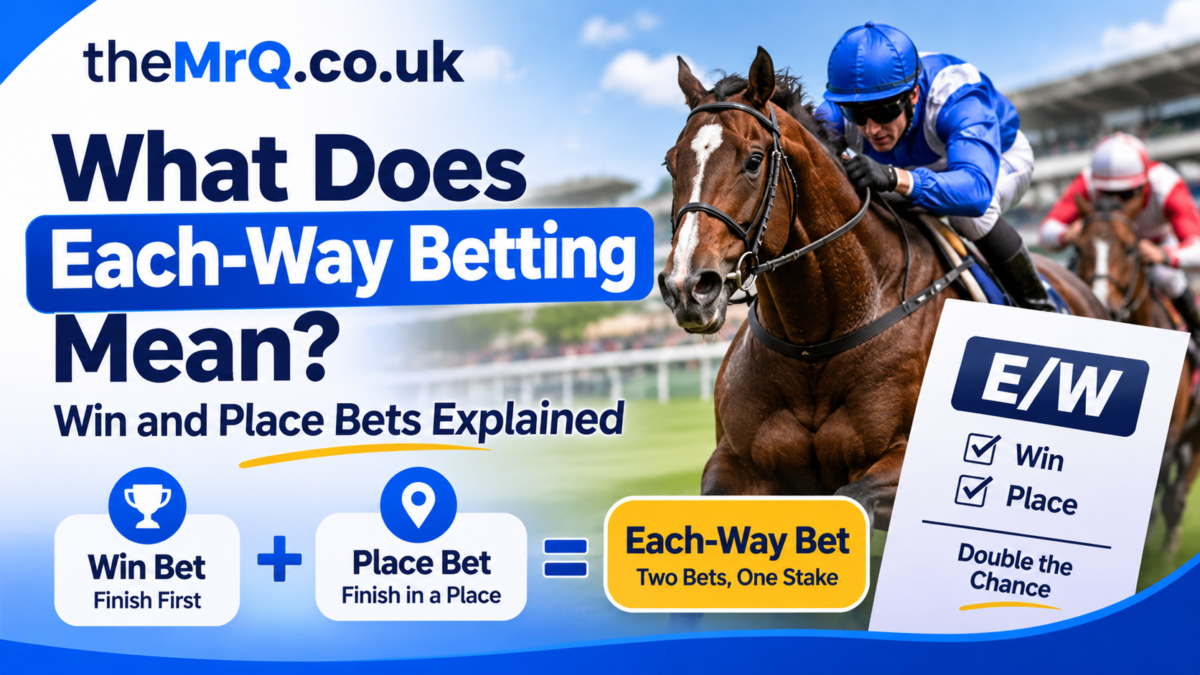
Pick up a racing card or glance at a betting slip and you’ll see “E/W” everywhere. It looks like jargon. It isn’t, really. An each-way bet is simply two separate bets bundled together: one on your selection to win, and one on it to finish in a qualifying place.
This each way betting explained guide covers how stakes are split, how place terms work and how returns are calculated, with a worked horse-racing example. It’s the kind of explainer you’d find in MrQ betting information, where we break down betting terms in plain English.
What Is an Each-Way Bet?
An each-way bet means you place two equal stakes. One goes on the selection to win. The other goes on it to place. That’s why it costs double a standard win-only bet.
Qualifying places depend on the bookmaker’s terms, so it’s not the same everywhere. A place might mean finishing in the top two, three or more, depending on the race. Always check before you bet, and use MrQ betting information to brush up on other terms you meet along the way.
Win Bet vs Place Bet: What’s the Difference?
The win part pays if your selection finishes first. The place part pays if it finishes in one of the specified qualifying positions. If your selection wins, both parts normally return a payout. If it only places, you’re paid on the place part alone.
Worth knowing: each-way bets belong to the sports betting world, not casino games. If you want the bigger picture, read casino betting vs sports betting.
How Does Each-Way Betting Work?
The flow is simple. You choose a selection, check the odds, check the number of qualifying places and the place fraction, then place your stake. After the race, the bookmaker settles each part separately.
Here’s the thing: the details matter more than the idea. The race odds, the number of places and the total stake all change what you could get back.
How Is an Each-Way Stake Divided?
A £5 each-way bet costs £10 in total. £5 goes on the win portion and £5 on the place portion. The “£5” you quote is the unit stake, not the full cost.
What Happens If Your Selection Wins or Places?
There are three possible outcomes:
- The selection wins. Both the win and place parts pay out.
- The selection places without winning. Only the place part pays.
- The selection finishes outside the qualifying positions. Neither part pays, and you lose the full stake.
How to Calculate Each-Way Betting Returns
Returns depend on three things: the original odds, your unit stake and the place fraction. The win part uses the full odds. The place part uses a fraction of them.
Example: £5 Each-Way Bet at 10/1 Odds
Take a hypothetical £5 each-way bet at 10/1, with place terms of 1/5 the win odds. These figures are illustrative, not a real race.
| Result | Win return | Place return | Total return |
| Horse wins | £55 | £15 | £70 |
| Horse places without winning | £0 | £15 | £15 |
| Horse finishes outside places | £0 | £0 | £0 |
The total original stake is £10. Returns include the stake coming back on any winning portion. So the net profit is £60 for a winning selection (£70 minus £10) and £5 for a place-only result (£15 minus £10).
Let’s check the win part. £5 at 10/1 wins £50 profit, plus your £5 stake back, which is £55. The place part uses 2/1 odds (more on that below), so £5 wins £10 profit, plus £5 back, which is £15.
How Are Place Odds Calculated?
Place terms are a fraction of the win odds, such as 1/4 or 1/5. You apply the fraction to the original odds. With 10/1 odds at 1/5 terms, the place odds are 2/1, because 10 divided by 5 is 2. With 1/4 terms, the same horse would be 2.5/1.
How Many Places Count in Each-Way Betting?
It varies. The number of qualifying positions depends on the number of runners, the race type, the bookmaker’s terms and any enhanced-place offers. Smaller fields may pay fewer places and larger fields more, but not every race pays the same.
What most people miss is that two things need checking together: the number of places and the place fraction. A generous number of places with a poor fraction might not be as good as it looks, and the reverse is also true. Look at both before you place the bet.
Each-Way Betting vs Win-Only Betting: What’s the Difference?
A win-only bet is one stake with one way to win. An each-way bet is two stakes, so it costs twice as much for the same unit stake, but it has two possible winning components.
The truth is, a place return doesn’t always mean you’re ahead. Because the place part pays reduced odds and you’ve paid double, a place-only result may return only a little more than your total stake. At short odds, it can return less than you staked. Check the maths before you bet.
Can You Place Each-Way Bets at MrQ?
Not currently. MrQ is primarily an online casino and bingo operator and doesn’t provide horse-racing or sportsbook betting markets. Each-way bets are tied to sportsbooks that offer suitable racing markets, not to standard casino games.
For more on that, see MrQ sports betting information. And if you’re wondering about the reasons, read why MrQ does not offer sports betting. It’s worth confirming the current position on the official site before you rely on it.
Final Thoughts
Each way betting explained comes down to this: two bets, two equal stakes, one for the win and one for the place. Know your total stake, check the place terms and understand the possible returns before you bet. For more plain-English explainers, head back to MrQ betting information. Betting involves financial risk and is restricted to eligible adults aged 18 and over, so only stake what you can afford to lose.
Frequently Asked Questions About Each-Way Betting
Does a £5 each-way bet cost £5 or £10?
£10. An each-way bet is two bets, one to win and one to place, and each carries the full unit stake. So £5 each-way costs £5 plus £5.
What happens if an each-way selection finishes second?
It may qualify for the place part, depending on the bookmaker’s terms. If second place is a qualifying position, the place portion pays and the win portion doesn’t.
Do you get paid twice if an each-way bet wins?
Effectively, yes. Both the win and place portions are settled separately. A winning selection normally pays on both, with the place part at the reduced odds.
What does 1/5 odds mean in each-way betting?
It’s the place fraction. The place part pays one fifth of the win odds. At 10/1, that’s 2/1 for the place portion.
Can you lose money even if an each-way bet places?
Yes. A place-only return can be smaller than the total amount staked, especially at short odds. In the 10/1 example, a place-only result returned £15 on a £10 stake, but at much shorter odds the place return could fall below your total outlay.